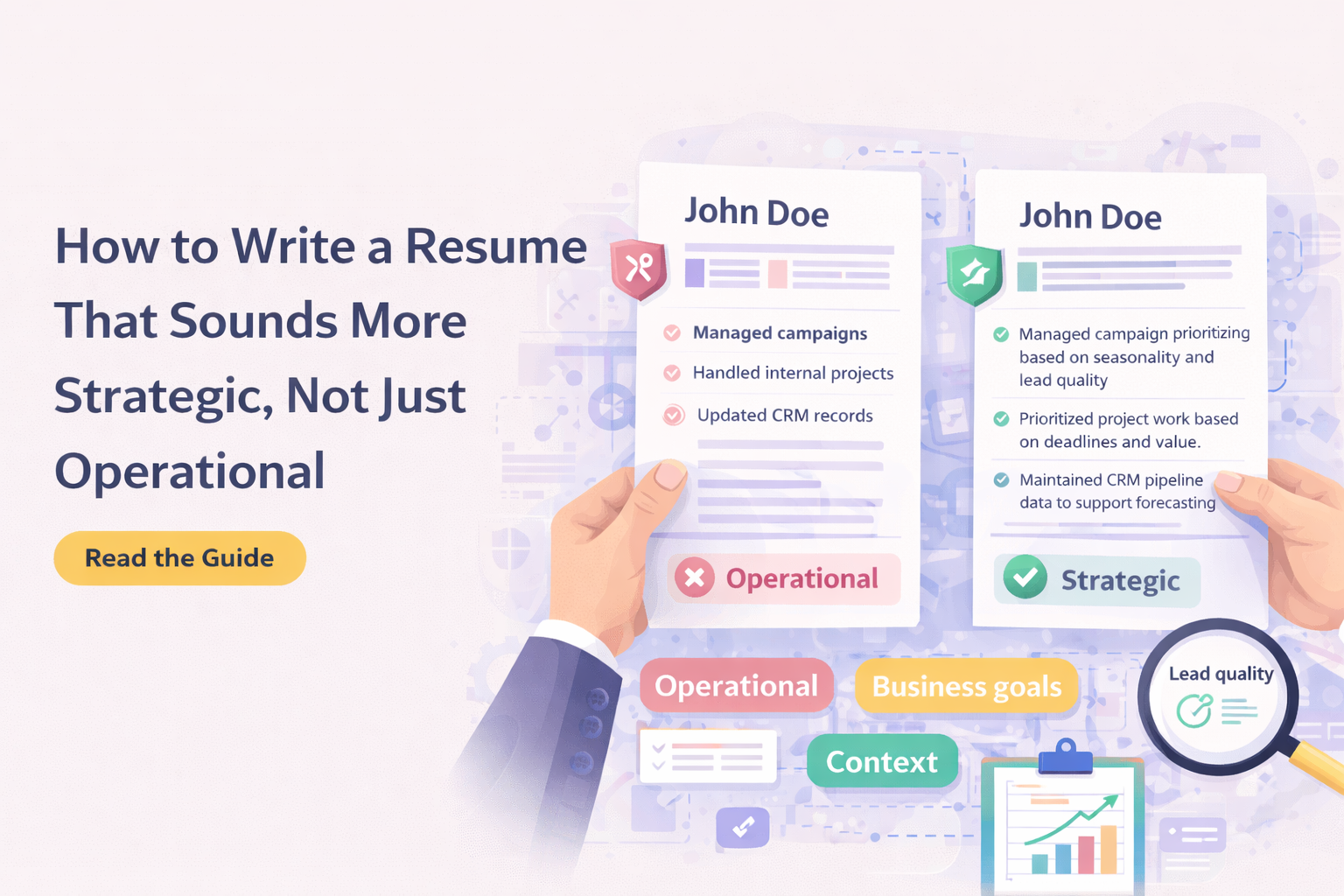
A resume often underperforms not because the candidate lacks strong experience, but because the document presents that experience only at the surface level. Many professionals accurately describe what they were responsible for, which systems they used, and which tasks they handled each week, yet the final result still reads flatter than the actual role they performed. Recruiters reading such resumes may understand the mechanics of the work, but they do not immediately see the thinking behind it.
This is one of the most common reasons why capable candidates receive weaker responses than expected. A resume that stays purely operational tells the reader what happened, but it does not explain how the candidate approached decisions, how priorities were managed, or how the work connected to broader objectives. In modern hiring, especially beyond junior roles, employers increasingly look for signals that a candidate understands not only execution, but also context.
Strategic language does not mean sounding exaggerated or artificially senior. It means allowing the resume to reveal how professional thinking influenced work. Many candidates already operate strategically every day without realizing that none of that judgment appears in the way they describe themselves.
What Recruiters Actually Mean When They Look for Strategic Thinking
When recruiters say that a resume should sound strategic, they are rarely asking for executive language. In most cases, they are looking for signs that the candidate understands why certain work mattered, how choices were made, and where effort influenced something larger than immediate output.
A sentence such as "Managed digital campaigns across several markets" is not wrong, but it leaves too many questions unanswered. A recruiter still does not know whether those campaigns were routine, whether priorities changed over time, whether the work involved budget decisions, or whether performance influenced next steps.
Strategic wording only creates value when the resume remains technically readable from the start, which is why understanding how applicant tracking systems process resumes remains a practical foundation.
When the same experience is framed with context, the impression changes significantly. If the sentence explains that campaigns were managed across several markets while budget priorities were adjusted according to lead quality, seasonality, or product demand, the recruiter immediately sees evidence of professional judgment.
This does not change the truth of the role. It simply reveals more of what was already happening inside the work.
Why Context Changes the Entire Strength of a Resume
Many resumes sound operational because they describe actions without showing purpose. Yet purpose is often where strategic value begins.
For example, saying that weekly reports were prepared tells the reader only that a recurring task existed. It does not explain why those reports mattered. When the same work is described as reporting used to identify underperforming acquisition channels or support monthly allocation decisions, the task suddenly becomes more meaningful.
The same principle applies across almost every profession. A dashboard is rarely important simply because it exists. It matters because someone used it to monitor performance, reduce uncertainty, or improve visibility. A launch plan matters because it coordinated dependencies. A CRM update matters because accurate data improved forecasting reliability.
Recruiters often respond strongly to this type of context because it helps them understand whether a candidate simply completed assignments or understood how work contributed to business decisions.
Strategic Language Often Comes from Showing Decision Logic
One of the strongest signals of strategic maturity is visible decision-making. Strategic language becomes even stronger when a resume also reflects influence and initiative, especially for candidates learning how to show leadership without having managed a team.
Many professionals make meaningful decisions daily but describe their work as though those decisions never existed. They write that projects were handled, campaigns were launched, systems were updated, or tasks were delivered, yet the resume never explains how one direction was chosen over another.
A stronger resume often introduces subtle evidence of reasoning. Instead of saying that multiple launches were handled simultaneously, a candidate can explain that launch timing was adjusted according to resource readiness, approval timelines, or regional priorities.
This small shift changes how the same experience feels.
The recruiter now sees someone who worked with awareness rather than someone who simply processed assigned work.
That difference matters because strategic candidates are often perceived as more independent, more trusted, and more capable of growth.
Why Prioritization Makes a Resume Sound More Mature
Strategy almost always involves deciding what deserves attention first.
Even in non-management roles, prioritization is one of the clearest indicators of professional maturity, yet it often disappears from resumes completely.
A sentence such as "Handled multiple internal projects" communicates activity but not judgment. A stronger version explains that projects were prioritized according to deadlines, commercial value, stakeholder urgency, or operational dependencies.
This matters because prioritization immediately suggests that the candidate understood competing pressures inside the role.
Employers often associate this with reliability. A person who demonstrates prioritization on paper appears more capable of functioning independently inside real work environments.
That perception becomes especially valuable when several candidates have similar technical backgrounds.
Cross-Functional Experience Is Often More Strategic Than Candidates Realize
Many professionals underestimate how important cross-functional collaboration appears in hiring decisions.
A resume may mention coordination with another team, but unless the interaction is explained properly, the strategic value remains hidden.
For example, saying "Worked with a product team" gives almost no insight. A recruiter does not know whether that meant simple communication, approval dependency, shared planning, or active contribution.
A more meaningful version would explain that campaign timing was aligned with product release schedules, reporting inputs were adjusted for finance reviews, or messaging was coordinated according to legal approval timelines.
Now the work feels connected to broader systems.
This is strategically important because professionals who work effectively across departments usually understand how organizations function beyond isolated tasks.
Recruiters often read that as a strong maturity signal.
Why Metrics Alone Are Not Enough
Many candidates assume that numbers automatically create stronger resumes. Metrics do improve credibility, but numbers by themselves rarely create strategic depth.
A sentence stating that performance improved by twelve percent is useful, but still incomplete if the resume does not explain what changed and why that improvement happened.
A stronger sentence may explain that conversion improved after budget pacing was adjusted according to seasonal demand or after onboarding messaging was restructured to reduce early user drop-off.
Now the metric becomes part of a professional decision story rather than an isolated number.
This matters because recruiters do not only want results. They want clues about whether the candidate understands how results were produced.
That understanding often predicts future performance more reliably than numbers alone.
Strategic Writing Does Not Require Leadership Titles
A common misconception is that strategic language belongs only to managers or directors. In reality, specialists often make strategic decisions every day, even without formal authority.
Choosing where to focus attention, identifying risks early, adjusting execution according to external constraints, and understanding downstream consequences all represent strategic thinking.
A specialist who improves reporting accuracy so forecasting becomes more reliable is already contributing strategically.
A coordinator who sequences work to prevent launch delays is already operating beyond simple execution.
A technical professional who adjusts implementation because of stakeholder dependencies is already showing business awareness.
The title does not determine whether strategic thinking exists.
The resume only needs to describe it clearly enough for an external reader to see it.
Why Resume Language Shapes Personal Brand More Than Most Candidates Expect
A resume is not only a record of experience. It also quietly communicates identity.
Two candidates may have similar backgrounds, yet one feels significantly stronger simply because the language reflects clearer thinking.
A strategically written resume often creates the impression of someone calm, structured, and aware of consequences. It suggests that the candidate understands not only their own tasks, but how work operates inside larger professional systems.
That impression becomes part of personal brand before any interview begins.
This is why wording matters more than many people assume. It does not change career history, but it changes how that history is interpreted.
Final Thoughts
A resume sounds strategic when it helps the reader understand how professional thinking shaped work. This does not require bigger claims, inflated vocabulary, or artificial leadership language. It requires stronger context, visible reasoning, and clearer explanation of why work mattered.
Many professionals already operate strategically without realizing how much of that maturity disappears when they describe themselves too narrowly. The strongest resume improvements often come not from adding achievements, but from allowing existing experience to reflect judgment more clearly. When that happens, the same career often begins to look significantly stronger.
Frequently Asked Questions
What makes a resume sound strategic?
A strategic resume explains what work was done, why it mattered, and how decisions influenced outcomes.
Can non-managers write strategic resumes?
Yes. Strategic thinking often appears through prioritization, judgment, and understanding business context.
Should operational tasks stay on the resume?
Yes, but they should include context that shows why they mattered.
Are metrics enough to create strategic positioning?
No. Metrics become much stronger when linked to reasoning and decision-making.
Why do many resumes sound too operational?
Because candidates often describe tasks without showing broader context.
Can strategic wording improve recruiter perception?
Yes. Strategic language often makes a candidate appear more mature and credible.
Does strategic writing help personal brand?
Yes. It makes a resume feel more thoughtful, structured, and professionally strong.