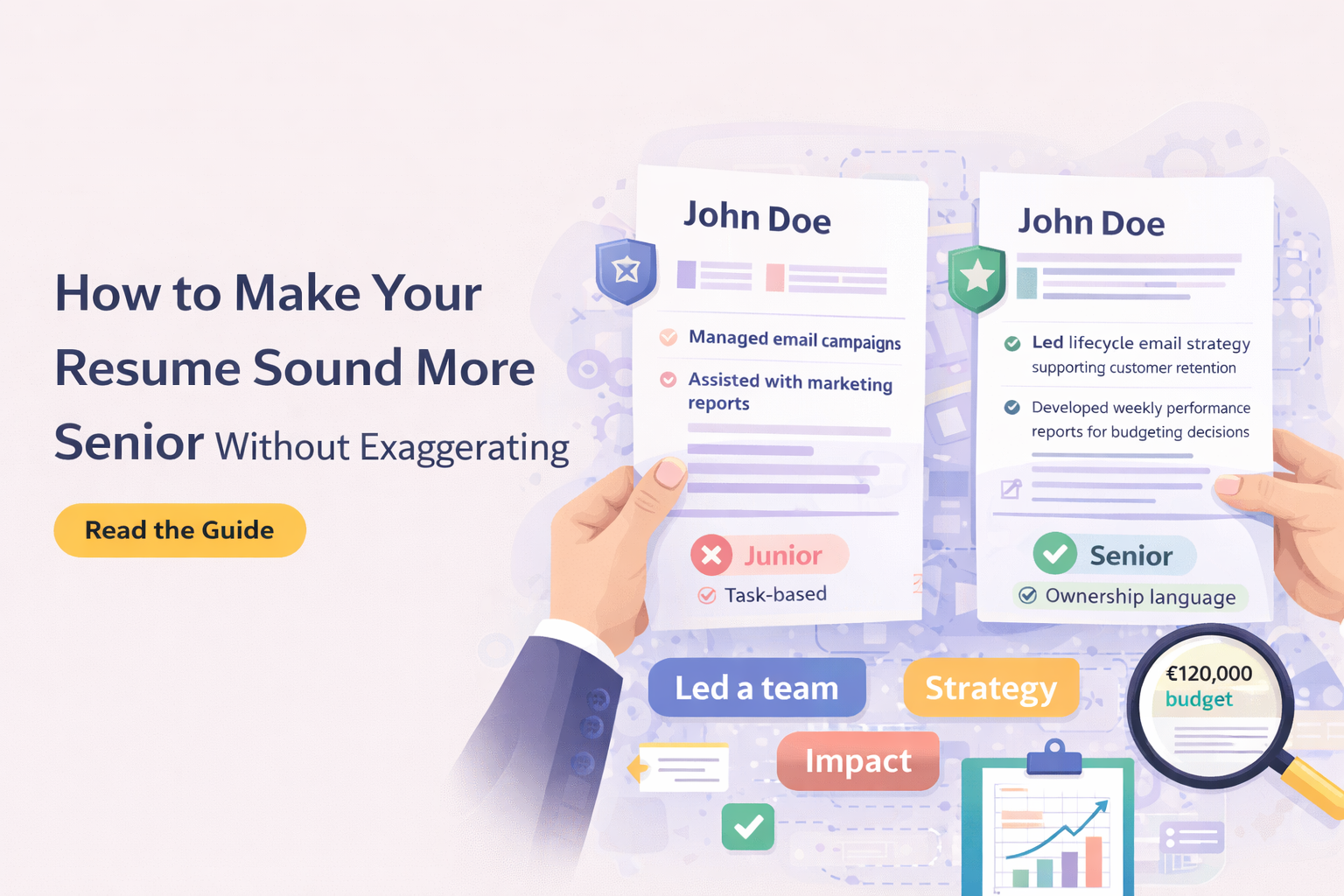
A large number of resumes fail not because the candidate lacks strong experience, but because the experience is presented in language that underplays scope, decision-making, and professional maturity. Two people may have worked at very similar levels of responsibility, yet one resume immediately communicates authority while the other reads as routine execution. In hiring, that difference matters more than many candidates realize.
Seniority on a resume is less about years of experience and more about the presence of professional judgment. It is about moving from describing what you did to explaining why you did it and how it influenced the environment around you. This clarity is an essential part of personal branding for experienced professionals.
Recruiters often form their first impression within seconds. They do not only look for years of experience or recognizable employers. They also read for signals of ownership, judgment, influence, and business understanding. A resume that sounds senior usually reflects these signals clearly, even before a recruiter studies details deeply.
This does not mean inflating achievements or inventing leadership. In fact, exaggeration usually creates inconsistencies that experienced recruiters quickly notice. Strong senior positioning comes from describing real work in language that properly reflects its level of impact.
Many candidates unknowingly write in a way that reduces perceived seniority. They focus only on tasks, omit decision-making context, hide strategic contributions, or describe important work too narrowly. The result is that genuine experience appears smaller than it actually was. A stronger resume does not make work look bigger than it was. It makes the real scope visible.
This guide explains how seniority is communicated in resume language, what changes increase credibility, how recruiters interpret authority signals, and how to strengthen professional positioning without overstating your role.
Why Seniority Is Often Communicated Through Language Before Job Titles
Job titles matter, but titles alone rarely define how senior a profile feels. Many companies use internal titles that do not translate clearly outside the organization. Someone may have held substantial ownership under a title that sounds mid-level, while another candidate may have had a stronger title with narrower responsibility. Because of this, recruiters quickly look beyond titles into wording.
The difference often appears in sentence construction.
A junior-sounding bullet often describes assigned activity:
"Prepared weekly reports for campaign performance."
A more senior version of the same real work may reflect ownership and purpose:
"Led weekly performance reporting used to guide budget allocation decisions across paid acquisition channels."
The underlying task may be similar, but the second version reveals why the work mattered, who used it, and where influence existed. Senior resumes often explain not only what was done, but how that work affected decisions.
Why Task-Based Writing Often Makes Experienced Candidates Look Smaller Than They Are
One of the most common resume weaknesses is excessive task description. Candidates often write as if documenting daily duties rather than professional outcomes. This usually happens because describing tasks feels safer than interpreting business impact. Yet recruiters do not hire based on activity volume. They hire based on relevance, scope, and evidence of judgment.
A sentence such as:
"Managed email campaigns."
says very little about level.
The same experience becomes much stronger when expanded truthfully:
"Managed lifecycle email campaigns supporting retention objectives across segmented customer groups."
Nothing has been exaggerated here. The work is simply described with clearer professional context. Senior resumes usually move away from raw activity lists and toward role meaning. That shift changes perception immediately.
How Scope Creates Seniority Signals
One of the strongest indicators of seniority is visible scope. Scope means understanding how large, complex, or consequential the work was.
This can include scale such as:
- budget size
- team size
- market coverage
- project complexity
- stakeholder involvement
- decision impact
A recruiter reading:
"Handled paid campaigns"
learns very little.
A recruiter reading:
"Managed multi-market paid acquisition campaigns across six regions with monthly spend exceeding €120,000"
immediately sees stronger scope.
The candidate may have already been doing this level of work for years, but if scope is hidden, the seniority signal disappears. Strong resumes surface scale wherever it exists naturally.
Why Decision Language Matters More Than Many Candidates Realize
Senior professionals are expected to influence choices. That influence does not always mean formal management authority. It often means judgment, prioritization, recommendations, and independent responsibility. Language that reflects decision contribution strengthens senior positioning.
For example:
"Created dashboard reports"
is weaker than:
"Built reporting dashboards used by leadership to evaluate quarterly performance trends."
The second sentence shows that the output mattered beyond execution.
Similarly:
"Worked with product team"
becomes stronger when written as:
"Partnered with product stakeholders to align campaign timing with release priorities."
This reveals business awareness rather than passive participation. Senior resumes often show where work connected to broader decisions.
Why Ownership Verbs Strongly Affect Perception
Verb choice changes tone significantly. Some verbs sound supportive. Some sound directive. This does not mean every sentence should begin with "led" or "owned," but verbs should accurately reflect true involvement.
Words such as:
- supported
- helped
- assisted
often reduce authority when overused.
In many cases, candidates used these verbs even when they had stronger ownership.
If the truth allows, stronger alternatives often improve clarity:
- managed
- developed
- coordinated
- implemented
- designed
- optimized
- directed
- initiated
For example:
"Helped improve onboarding process"
may actually be:
"Redesigned onboarding workflow to reduce drop-off during first user activation stage."
The second version is not exaggerated if the candidate genuinely did this work. It simply names the work more precisely.
Senior Resumes Usually Reveal Cross-Functional Exposure
As careers progress, work rarely stays isolated. Even non-managerial professionals increasingly interact across teams. That cross-functional exposure often signals maturity.
A senior tone becomes more convincing when achievements are framed through business impact, which is why many candidates also improve results by learning how to make resume language sound more strategic.
Recruiters notice when resumes mention collaboration with:
- finance
- sales
- product
- operations
- legal
- leadership
because this suggests the candidate understands business beyond narrow execution.
A sentence such as:
"Worked with designers"
can often be improved into:
"Coordinated with design and product teams to align creative delivery with launch deadlines."
This adds organizational context. Senior professionals usually operate inside wider systems, and resumes should reflect that.
Why Measured Impact Creates Immediate Credibility
Numbers often strengthen seniority because they reduce ambiguity. Without numbers, even strong work can feel abstract. This does not mean every bullet requires metrics, but where impact can be quantified, credibility increases sharply.
For example:
"Increased lead quality through landing page improvements"
becomes stronger as:
"Improved landing page conversion rate by 14% while reducing acquisition cost."
The metric signals maturity because it shows evaluation, not just action. Senior resumes often combine business language with measured evidence. That combination is difficult to fake and easy to trust.
Why Seniority Does Not Mean Pretending to Be a Manager
Many candidates think sounding senior means sounding managerial. This is not always true. A highly valuable specialist can sound senior without direct reports. What matters is depth of ownership, judgment, technical maturity, and business contribution.
A strong senior specialist resume may show:
- deep technical expertise
- process ownership
- high-stakes execution
- strategic recommendations
- trusted independence
This is seniority even without formal leadership. Recruiters understand this distinction well. The mistake happens when candidates erase specialist depth because they think only management sounds senior. Often, expert authority is stronger than artificial leadership language.
Recruiters also associate seniority with visible ownership, which makes it useful to understand how to reflect leadership without a formal management title.
How Personal Brand and Seniority Connect
A resume is not only a record of work. It is also a professional positioning tool. The way experience is described influences how recruiters imagine the person behind the document. A resume that sounds fragmented often creates uncertainty. A resume that sounds calm, precise, and intentional usually creates stronger confidence. This is where personal brand quietly appears.
Senior professionals often sound:
- clear
- measured
- specific
- business-aware
This tone itself becomes part of perceived credibility. Strong personal brand is often less about style and more about disciplined clarity.
How ResumeCraftor Helps Candidates Strengthen Senior Positioning
One of the hardest things for candidates is seeing where their own language reduces their professional level. People often underestimate themselves because their work feels familiar.
ResumeCraftor helps surface stronger wording patterns while keeping achievements truthful and aligned with actual experience.
This allows candidates to present real authority more clearly rather than artificially inflating credentials. That distinction matters. Recruiters respond best when resumes sound naturally strong, not engineered.
Common Mistakes That Make Experienced Candidates Sound More Junior
A frequent mistake is writing every bullet in identical task format. Another is removing context that explains why work mattered. Some candidates also overuse passive phrasing, which weakens authority.
Others hide major scope because they assume budget size, complexity, or stakeholder visibility are obvious. Nothing is obvious to an external recruiter. The resume must make these things visible. Seniority often disappears simply because context is missing.
Final Thoughts
A resume sounds senior when it reflects real scope, ownership, judgment, and impact clearly. This does not require exaggeration. In fact, exaggeration usually weakens credibility because it creates tension between language and likely reality.
The strongest senior resumes usually feel calm, specific, and professionally confident. They show what mattered, who benefited, and where responsibility existed. Many candidates already have stronger experience than their resumes suggest. The difference is often not career level. It is language precision. When that precision improves, seniority becomes easier to recognize.
Frequently Asked Questions
How can I make my resume sound more senior?
Focus on ownership, scope, decision-making, and measurable outcomes rather than only tasks.
Does sounding senior mean exaggerating achievements?
No, the goal is clearer positioning of real work, not inflation.
Can specialists sound senior without managing people?
Yes, deep ownership and expertise often communicate seniority clearly.